Tuesday, November 2, 2010
Fast-track to the emotions
Tuesday, October 5, 2010
sheep food . . . and more!
Saturday, September 11, 2010
The red, hot questions . . .Charlie and the Red Hot Chilli Pepper
Hello and a big, red hot welcome to my dear writing friend and colleague, Sheryl Gwyther, whose Pearson chapter book,Charlie and the Red Hot Chilli Pepper, has just been released. It's a great story with plenty of problems, humour and determination woven throughout and perfect for the chapter reading age group!
I wanted to ask Sheryl more about the book and her writing in general.

Can you tell us what was the initial trigger for this story, and what are three other related ideas you used to help create or develop it?
When I decided to write a story about someone who was crazy about growing and eating chillies, young Charlie jumped into my head and the story took off.
What was your method in working on this book? Was it mainly plot or character driven?
I did have a strong vision about what Charlie was like, but I also had to come up with a plot that would keep the reader wanting to know how Charlie would solve her dilemma. Would she and her Habanero win with all the obstacles put in her way? Then it was a matter of imagining lots of situations where chillies could cause problems.
Were there any surprises that happened along the writing journey?
You bet your guacamole boots there was, Janeen! When I first began to plan this story, I didn’t realise how much fun it would be actually writing it. Charlie was such a strong character in my head, sometimes it was like I was thinking through her head, not mine. Very surprising!! I also got a very big surprise when a possum ate a chilli from the FIERY Habanero plant in my garden. I didn’t know possums ate chillies! Maybe that possum got such a shock it never ate a chilli again.
I learned a number of things while reading the story; for example, milk cools the mouth after eating hot, spicy food. Did you find you needed to do a lot of research?
I love researching for all my stories – partly because I enjoy researching and mostly because it’s good to know the ‘ins and outs’ of the subject matter – whether it’s about dinosaur fossils out in western Queensland (in my novel, Secrets of Eromanga), or learning to juggle when I wrote Princess Clown (I failed at the fourth ball toss), or some amazing things I found out about chillies while writing Charlie & the Red Hot Chilli Pepper.
Did you know that birds can eat the hottest chillies possible with no ill effects? Why? Because their internal system can cope with the chilli’s capsaicin (burn-factor chemical), the chilli seed passes through their gullet quickly and is dispersed further from the mother plant ... more chance of survival for the new chilli plants!
Of course, the reason why the chilli is so hot for everything else is to stop it being eaten and destroyed – the seed does not survive in the intestines of all other animals (including humans). Clever chillies! Clearly, my possum thinks he’s a bird.
I love the element of music in the story. Do you find music is an element that appears in your stories, or are there more predominant ‘Sheryl passions’ like art, geology or palaeontology?
Clever you, Janeen, to pick up another one of my passions! Yes, the element of music is present in many of the stories I write, even if I don’t mention it in the story. Music has rhythm, just like words and sentences.
Music also has colour and I like to bring ‘colour’ to stories – that’s the element that keeps a plot and characters interesting to the reader. I play music on my stereo while I write – from classical, to jazz, to Cuban, to rock and Celtic music. Some people need silence to write, I like music!
Charlie and the Red Hot Chilli Pepper is published by Pearson in their new series, Chapters. Tell us what it was like writing for the Educational Market.
I started writing chapter books for the Education Market late last year – it was a pleasant surprise. I’ve had two published for this market so far. No-one in those two publishing houses told me I had to use word-lists, nobody stopped me using longer, more complicated words that would challenge a child (like soufflĂ© and circlet).
The books themselves are professionally produced, and I’m really happy with the end product. And best thing of all, I am delighted to be the author of chapter books – the first ‘real’ books that young readers tackle by themselves.
Princess Clown was the first book I wrote for the education market. Blake published it a month ago and I was thrilled with how it turned out. Sian Naylor’s illustrations are brilliant (and very clever!) and I love their extension activities in the back of the book.
Pearson did a fantastic job with Charlie and the RHCP too. The book’s illustrator, Richard Hoit has captured Charlie’s enthusiastic face and all the pictures are just right for the story. He even got the shape and colour right for the Habanero chilli on the front cover.
Both Charlie and the RHCP and Princess Clown are available from the publishers on the internet. Some schools already have copies and Charlie could also be in some bookshops by now.
I’m having a book launch in October for Charlie and the RHCP in Brisbane – everyone is welcome! It’s at Black Cat Books in Paddington, Brisbane on 22nd October, 2010, at 6pm. Phone: 07 3367 8777
What are you writing now?
I have several stories 'on the boil'. Three are longer novels and one is a shorter length to suit the 9-10 age group. I'm enjoying writing this story - Fangus Fearbottom is a young vampire who would rather eat bananas than drink blood, so he's having heaps of funny adventures.
I'm hoping to develop it into a series as I have lots of ideas that could cause conflict for poor Fangus (I wonder how he will solve his banana-dilemma?)
Thank you so much for inviting me to talk on your blog, Janeen. I’ve thoroughly enjoyed it! If any of your readers would like to know more about writing chapter books, I’ve written a blog on the subject.
Here is the link for it on the Kids Book Review site. http://kids-book-review.blogspot.com/2010/08/guest-post-on-writing-perfectly.html
OTHER LINKS:
Princess Clown http://www.blake.com.au/Gigglers-Blue-2-Princess-Clown-p/9781741646481.htm
Charlie and the Red Hot Chilli Pepper http://www.hi.com.au/bookstore/bmoredetail.asp?idVal=2645/6381/44682
Secrets of Eromanga
http://sherylgwyther4kids.wordpress.com/books/secrets-of-eromanga/
For more information on my writing and art work:
http://sherylgwyther.wordpress.com
http://sherylgwyther4kids.wordpress.com
Thanks Sheryl, for such great answers and best wishes for your terrific book. By the way, I am also a lover of the shape and shine of chillies!
Sunday, August 29, 2010
the yellow breezes . . .of poetry
Many school visits of late and treks around the suburbs and hills reminds me that our native wattle is such a great emblem. What varieties and what blazes of colour.
During my school sessions, I often began using an iddy-biddy poem of mine about wattle. Because it related to the current season, I thought it might help kids become more aware of their environment.
Also it was a fun, interactive way to begin.
The whole poem is:
Yellow breezes
bring the sneezes
all from fluffy, wattle, treeses.
I wrote all but the last three words on the board and left the kids curious, while I talked about yellow breezes. Can we see breezes? Can we see the wind? If not, what can we see? And why a colour breeze? At that point some worked out that wattle trees were somehow involved. I then spoke about choosing the right words for the job. How to tighten the line of a poem by connecting only two main words to create a word picture.
We then moved on to bring the sneezes; the meaning of which they worked out fairly easily. Then rhyme was mentioned.
The last part was interesting. We tapped or clapped the rhythm of the whole poem and I emphasised that we’d need words that were consistent with that pattern. What words could we use? What would be appropriate to the context of the poem? If they gave me a one syllable word, for example, fun, I wrote it up, and read the last line using that word, so the children could hear the difference in beat, before asking for another suggestion. I urged them also to consider the meaning of the poem.
Finally they completed the first two words, fluffy and wattle, but became stuck on the last word. I talked about playing with words and how you can make up words as long as the meaning is not too obscure. When someone offered treeses, there was a mixture of reactions. Some children latched on quickly, others not so fast. But lots of, ‘Ahh! I get it’ or ‘I was going to say that!’
I write both rhyming and non-rhyming poetry, but through this little poem I was able to talk about quite a number of aspects of writing; keeping it tight and simple, using spare, important adjectives, and breaking a rule or two - just for fun!
Monday, August 16, 2010
the tandem camel blog
. . .then and afterwards


Every book has its own story. The one the author intended to be read. But what are also fascinating are the countless mini-stories that occur as you, the author, create that one book.Creating books lend itself to all sorts of serendipitous happenings, in all forms. Have you ever discovered a piece of information that seems to have been sitting around simply waiting for you to unearth it? Has there been an odd comment uttered innocently in an everyday conversation that somehow gave you a whole new slant on your book? Or have you discovered an object that evoked an idea - or was perfect in some other way? Claire Saxby once found a soft toy, blue whale in the gutter. She’d searched seriously in shops and other venues for just such a thing to use in an activity for her picture book, There Was an Old Sailor, but had had no success. What are the chances of that happening?

These mini-stories are endlessly fascinating to us as writers and readers. They’re like barnacles that adhere, one by one, to the main jetty pole, adding to its shape and texture.But equally intriguing is what happens to our books afterwards? I don’t necessarily mean at the launch or during those rigorous inroads of self-promotion. I mean the ones you don’t expect, the the surprises that add another layer or two to your fully completed written book.
Perhaps you never expected your book to turn up written in Braille? Or that your story would become a film. Or that a letter arrives from a stranger, explaining that your book was the first one their child had read from beginning to end.
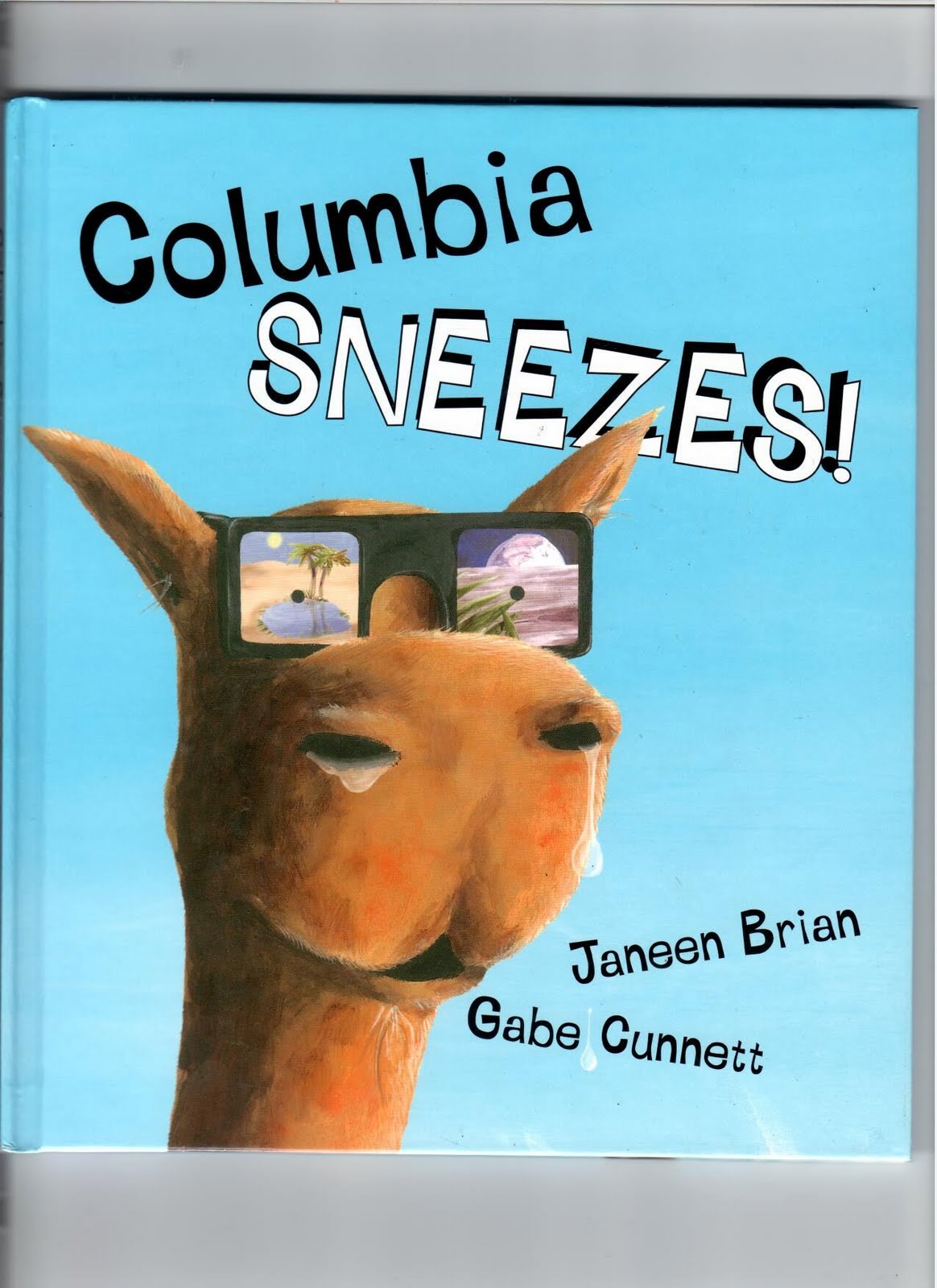
My camel books, the award-winning, information book Hoosh! Camels in Australia (ABC Books, 2005) and the picture book Columbia Sneezes! (Omnibus/Scholastic, 2008, illustrated by Gabe Cunnett) now have several such legacies. As such, they have consciously or subconsciously enriched the book for me.
They’ve also demonstrated that while each book itself is tangible and complete, they still pulse with possibilities.
Let me share a couple of afterwards stories with you.
During the research of Hoosh!, I was extremely grateful to the knowledge of Peter Seidel, Executive Officer of the Central Australian Camel Industry Association. He answered zillions of my layman type questions by phone or email, met me in Adelaide for an interview and provided me with industry information and photos. After the book’s publication, Peter proudly offered Hoosh! as a business gift, to many of his clients in US, Japan and Saudi Arabia, buyers of fine, disease-free Australian camels for the prestigious camel racing circuit.
Hoosh! also found a place in a display case in the South Australian Museum travelling exhibition called Australia’s Muslim Cameleers; Pioneers of the Inland, 1860s – 19303. The exhibition has travelled to many capital and regional cities in Australia since 2007 and is still on the move!
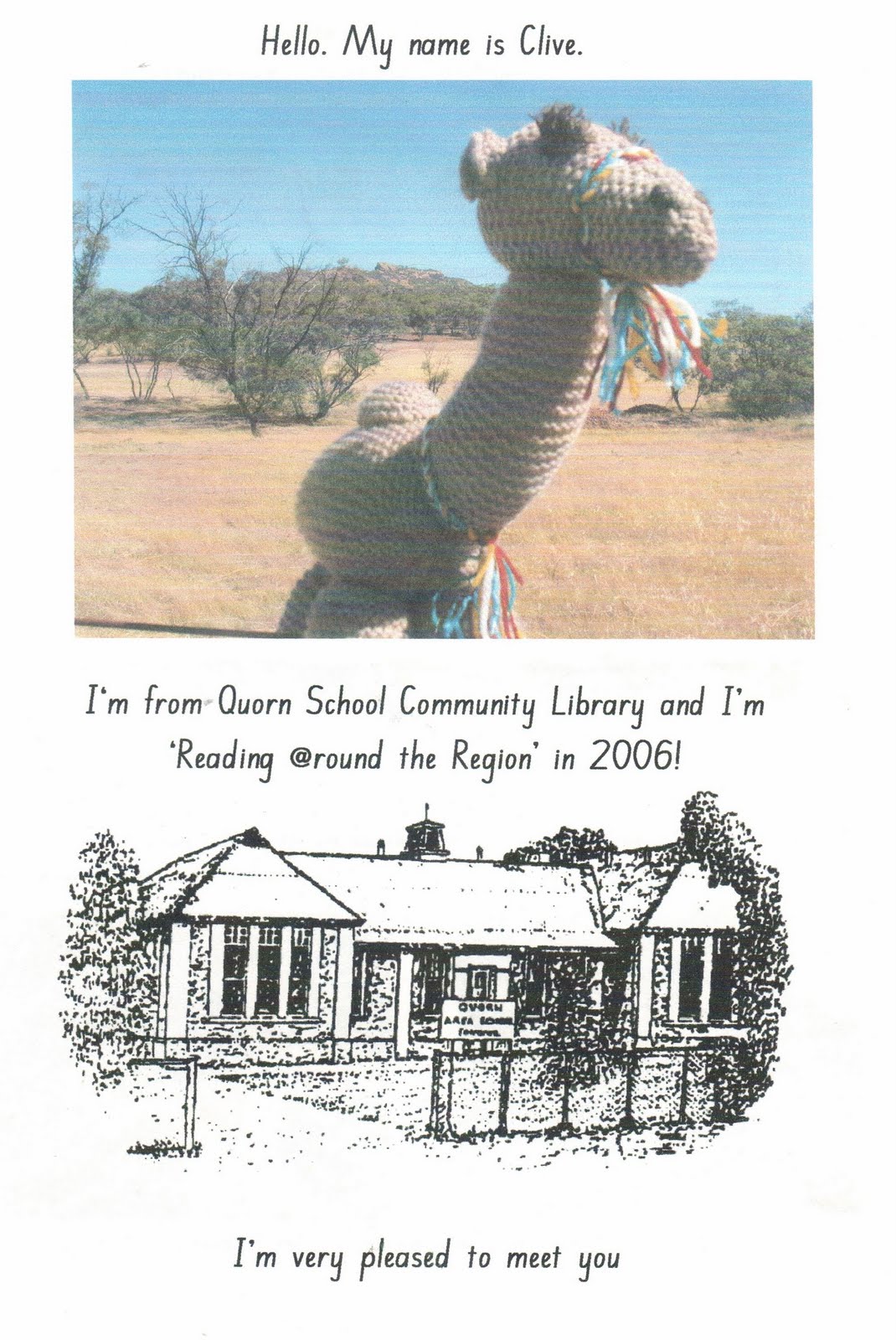
A copy of Hoosh! was placed in a little travelling bag, organised by the Quorn School Community Library, to celebrate ‘Reading @round the Region in 2006. The bag also contained other camel bits and pieces such as the picture book, Little Humpty, photos from Pichi Richi Camel Tours and a pattern to knit a little camel, like Clive! This ‘camel bag’ was sent to outback and remote schools and libraries in the far north of SA for children and parents to use in their reading time.
In 2006, Hoosh! brought home an Honour Award in the Eve Pownall section for Information Books in the Children’s Book Council of Australia Awards.
Later young children devised a song with a string of verses, each including a fact discovered while reading Hoosh!
To the tune of ‘Go, Alice, Go!’ the first verse is:
Hoosh, the camel, has one hump.
Go, dromedary, go,
Boom! Boom! Boom!
(lots of fun, especially if you swing your rear from side to side like a camel in the last line!)
And from Hoosh! evolved the picture book, Columbia Sneezes! It grew from a story devised by my grandson and I about a little soft toy camel I’d bought while doing fieldwork at The Voyages Camel Cup in Alice Springs.
Columbia spawned an amazing camel construction made entirely of balloons at the CLIC (Children’s Literature in the Centre) Festival in 2008! And a permanent sculpture is to be made of Columbia and set in a Storyboard Walk in a park in South Australia.
None of these eventualities could’ve been foreseen. But what joy it is to see your work remain malleable and to appear in various ways and venues previously unimagined.
There’s another bonus too. I’ve looked over those happy legacies again. And do you know, they could spark off a few self-promotional ideas for other books!
What are some of your special during and afterwards stories?
Monday, August 2, 2010
a picnic of poetry

Today we welcome poet and children’s author, Lorraine Marwood. Lorraine’s recent poetry highlights have been the publication of the verse novels Ratwhiskers and Me, and Star Jumps. Star Jumps is certainly leaping high! It’s a Notable in the 2010 CBCA Awards, shortlisted for the Speech Pathology Awards and more recently, shortlisted in the Prime Minister’s Literary Awards. But today we celebrate Lorraine’s latest publication from Walker Books; an anthology called A Ute Picnic – and other Australian Poems.
Whose idea was it to create this anthology, yours or the publishers? Both, this collection has taken awhile, a few years actually. My publisher is a great fan of poetry and that's the spark to ignite a book like this.
I love the title – taken from one of the poems. Does it have any special significance for you?
Yes 'A Ute Picnic' was one of my first prose/poetry ventures. It was first published in School Magazine and was the forerunner for the style of my latest verse novels 'Ratwhiskers and Me' and 'Star jumps.' It also explored a real occurrence on a farm- during hay harvest when a ute picnic would have to be taken to my husband several kilometres away- no corner stores way out in the country.
We experience many senses when we read your poems. How many senses are in play when you are first collecting ideas?
Now that's an interesting question! I love to find an atmosphere, a perspective that is uniquely mine and the senses provide a way into this especially sound- I also add a sixth sense- emotion- or personal involvement with the topic of the poem- this ensures there's some emotional content for the reader also.
In a recent interview about verse novels with Sally Murphy, you spoke of ‘propelling the bare bones of the story.’ Your poems are rich bare bones. Tell us how you pare down.
I also wanted to be an artist (as well as an author) when I was younger... so making an art work with words is very important. Keeping to the essentials of poetry like strong details, strong nouns and verbs helps paint that spare richness, then it becomes part of my style, my poetic voice. My family often tells me that I say some strange things- its the way my brain works!
In Star Jumps you wanted children to experience the reality of farm life, as opposed to the romantic version. Were you thinking in those terms with this collection as well? Tell us how the collection evolved.
A lot of these poems come from fragments of my writing journal written over a decade and more- I really wish I'd started my journalling a long time before that- but life was hectic on a dairy farm with six kids and I suppressed my writing for so long. Yes I wanted the real touches of life on a farm to come through, the real grit, the real epiphanies, the real thread of umbilical chord tied from farming family to the seasons of dairy farm. One really observes weather, insect life, plant life, changes in a detailed way when one's livelihood and lifestyle are intertwined with the land.
Some poems were just sitting there in my note books, waiting to be plucked- they needed dusting down, shining up to make them convey their own message- others were written from a few words which immediately re-evoked the situation for me- for example- the poem called 'A Joke' was a real incident that happened- well all the poems in this collection are real life incidents.
What is your favourite place for writing poems from your notes or ideas? Now it’s at the kitchen table- wherever inspiration happens- after writing whenever I could with a big family- I can nearly write anywhere. Well nearly.
I must add that the dedication for this book goes to my great writing friends Janeen and Claire- both poets and both great encouragers along the twists and turns of the writing landscape.
Thanks Janeen for such perceptive questions and the opportunity to come and visit your blog.
Thanks Lorraine. We wish you well with this next wonderful, poetry offering. I am a great fan of your work!