Hi - exciting news! I've just launched my brand new website and blog. You can find the latest news on my books and what I've been up to at www.janeenbrian.com.au or on Facebook
Hope to see you there soon.
Kind regards,
Janeen
Tuesday, December 3, 2013


Sunday, June 23, 2013
That Boy, Jack launch
Oh, what a feeling!


+Nick+(son-in-law)+Peter+(friend).jpg)
After months of planning, my children's, historical novel is officially launched. That Boy, Jack (Walker Books) has taken over 10 years to get published. Now it's out there. Happy reading, everyone.
It was a happy day!
 |
| Such a stunning cover. Thanks Walker Books! |
 |
| Wonderful music by The Celtic Daughters opened the event. |
 | ||
Ex-student and now family friend, James Quigley, was the perfect MC.
|


With the book at last!

Jack took a liking to the Cornish pasties!
 |
| Friend, Wendy Johnson, reading out winning ticket of the door prize. |
 |
| Members of the Adelaide Cornish Choir singing traditional songs. |
 |
| Book buying! |
 |
| The crowd in the great Function Centre at Immanuel College, Novar Gardens, SA. |
 |
| A great day. |
 |
| Happily signing away. |
 |
| Members of The Celtic Daughters plus Isabel, who also played her debut performance. |
 |
| Mike Lucas of Shakespeare's Bookshop, Pt Noarlunga. |
 |
| Daughter, Cass and grandson, Liam. |
 |
| Baby grandson, Saxon. |
 |
| Daughter, Nat, and baby Saxon. |
.jpg) |
| Sister, Jo and cousin, Sue. (Left to Right) |
+Nick+(son-in-law)+Peter+(friend).jpg)
My husband, Jon, son-in-law, Nick and friend, Peter. (from Left to Right)
Friday, June 21, 2013
After the book - more surprises.
after the book . . .more surprises.
 |
| Children at St. Anthony's did an action play and . . . |
 |
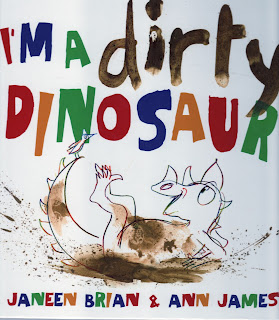
| children at Somerton Park Kindergarten created a dinosaur after hearing the story . . . |

love it!
Friday, May 24, 2013
It's Festival time!
The two words Kernewek Lowender, mean Cornish happiness and
is the name for the biennial Cornish Festival which occurs in the old copper mining
towns of Moonta, Kadina and Wallaroo on South Australia’s Yorke Peninsula.

It’s a time for Maypole and Furry dancing, singing, wrestling
and historic walks, for parades, pasties, poetry and more, all to celebrate the
Cornish culture that came to Australia through the early immigrant miners and
their families who arrived in sailing ships from Cornwall from 1840's onwards.


I was thrilled to have a special Cornish launch of my historical,
children’s novel That boy, Jack, (Walker Books) which
is set in the heart of the copper mining region, during this week's festival. And to
know that my ancestors were miners who made a new life in South Australia.

It
was made especially memorable because my friend and writing colleague, Rosanne
Hawke, herself of Cornish ancestry and acknowledged as a Bard of Cornwall, launched the book.

She will also
launch it at a city event on Monday, June 10th, 2013.
Sunday, April 14, 2013
when THIS becomes THAT
It started as a seaside
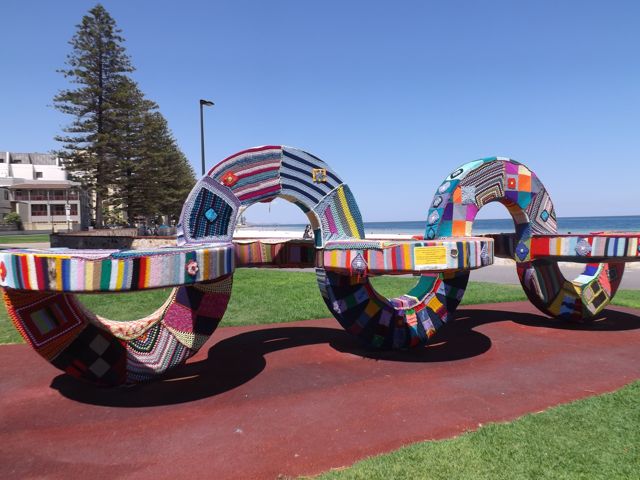
sculpture that’d been YARN-BOMBED. The community of Holdfast Bay, SA, including
me, KNITTED, CROCHETED and finally STITCHED wool scraps around the metal
creation called RHYTHM.
The brightly coloured
shape ENLIVENED the environment and gave FUN and PLEASURE to all for a month.
But what was to happen
to the sculptured pieces afterwards? Had they reached their used-by date?

My picture book, SHIRL AND THE WOLLOMBY SHOW provided the
answer.
The resolution of Shirl
the Sheep’s problem was to use remnants of knitting and create a SCARECROW.
With the help of artist,
Violet Cooper, the Holdfast Bay Community Development Officer, Jenni Reynolds
organised a children’s workshop, called SCRAPPY SCARECROWS.
At the workshop we created
Rex the Scarecrow, and his friends, Harry the Duck and Scare-Dog.


 |
 |
| Meet Rex the Scarecrow, Harry the Duck and Scare-dog. |
At the moment they’re display treasures at the local libraries . . .but after that? Well, they’ll be off to live in a newly created Community Garden in North Glenelg, SA.
Just where a scarecrow and friends should be!
What a lovely recycling story.
Wednesday, April 3, 2013
Melbourne and More!
Loved my time in Melbourne recently!
Had a great meeting with Erica Wagner, publisher of Allen & Unwin who will be publishing my next book: a picture-poetry book called Village Child, illustrated by the multi-award winning, talented Anne Spudvilas, due out in 2014.
A brief but nice catch-up with my agent, Jacinta di Mase and her children, at the State Library of Victoria Children's Book Festival.
I was blown away, so impressed, with this well-attended event. I heard approximately 15,000 families and children enjoyed the day.
While I read the book, during the afternoon, over a hundred children had fun making their own Ned Kelly masks.


Had a great meeting with Erica Wagner, publisher of Allen & Unwin who will be publishing my next book: a picture-poetry book called Village Child, illustrated by the multi-award winning, talented Anne Spudvilas, due out in 2014.
 |
| Anne's rough of the book's intro |
A brief but nice catch-up with my agent, Jacinta di Mase and her children, at the State Library of Victoria Children's Book Festival.
I was blown away, so impressed, with this well-attended event. I heard approximately 15,000 families and children enjoyed the day.
 |
Me just arrived at the Random House tent to promote my picture book, Meet Ned Kelly, illustrated by Matt Adams. |
While I read the book, during the afternoon, over a hundred children had fun making their own Ned Kelly masks.


Also spied in the crowds, friends and writing colleagues Claire Saxby and Meredith Costain.
Thanks Random House and thanks Melbourne.
Sunday, March 3, 2013
Kids Day at Adelaide Writers' Week
Beneath huge, leafy plane trees and among its shadows are hundreds or readers and writers and tents and children dressed up or listening and watching creators in the Story Tent.


I was especially chuffed to be asked to present in the Story Tent. Why? I had my two new picture books, I'm a dirty dinosaur and Meet Ned Kelly, to read and celebrate! The tent was full to overflowing with toddlers, older children, parents, grandparents and others interested.


It's Kids Day at the highly-regarded Adelaide Writers' Week and the first time the free festival has been held annually.

I was especially chuffed to be asked to present in the Story Tent. Why? I had my two new picture books, I'm a dirty dinosaur and Meet Ned Kelly, to read and celebrate! The tent was full to overflowing with toddlers, older children, parents, grandparents and others interested.

It was a great time. And my new books sold out.
Subscribe to:
Posts (Atom)